Improving access to cognitive aid
Exploring how parents of children with neurodevelopmental conditions navigate NAV’s digital services to find cognitive assistive technology.
Role
UX Researcher & Interaction Designer
Team
2 interaction design students
Timeline
3 weeks
Methods
User testing
Expert Interviews
Affinity Mapping
Concept Development
The Challange
Finding the right support should not require knowing where to look
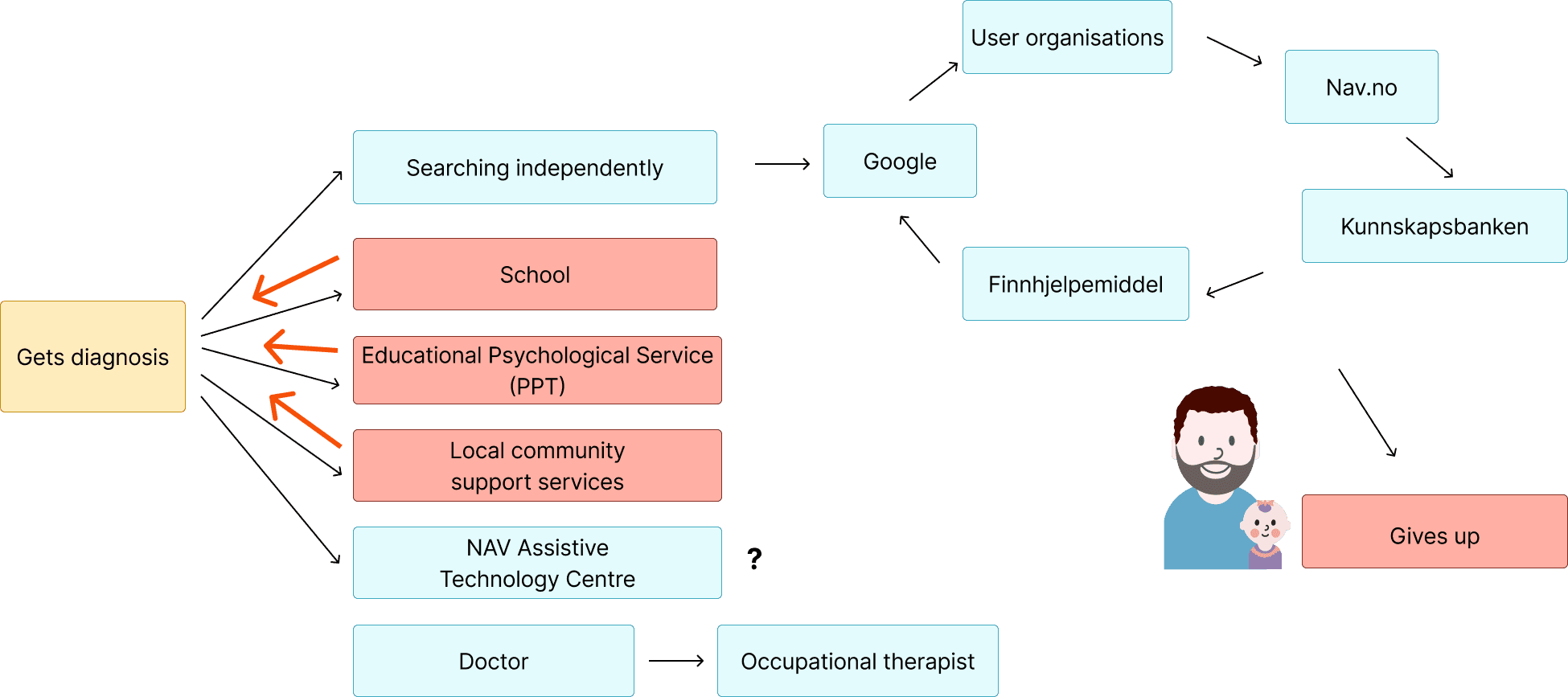
Parents of children with neurodevelopmental conditions may need to navigate several services and sources of information when looking for cognitive assistive technology. Our initial research showed that the journey could begin in many different places, from healthcare professionals to Google, NAV and user organizations. A key challenge was that users struggled to find an obvious starting point or a clear path forward.
This led us to explore
How can we make it easier for parents of children with neurodevelopmental conditions to discover and navigate relevant cognitive assistive technology?
Research: Two Perspectives
Parents/Users
Parents participated in interviews and usability tests to help us understand how they searched for information, where they expected to find support, and where they experienced difficulties.
Experts
We interviewed professionals with experience in neurodevelopmental conditions and assistive technology to understand the system, common challenges and how parents are supported throughout the process.
Understanding the user journey
We wanted to see what happened when parents actually tried to find relevant support.
Participants were given a scenario in which their child had recently received a diagnosis and were asked to find relevant cognitive assistive technology. Rather than directing them to a specific page, we observed where they chose to start, how they navigated between services and where they experienced friction.
Making sence of the research
We brought insights from the interviews and usability tests together in affinity maps. Observations, quotes and recurring difficulties were grouped into themes, allowing us to compare the experiences of parents with the perspectives of experts and identify patterns across the journey.
This helped us identify recurring points of friction and understand where parents were most likely to lose direction.

Key Findings
01 - Information is difficult to find and understand
Users struggled to locate and interpret relevant information on NAV's websites. Navigation, terminology and visual elements did not always communicate their purpose clearly, making it difficult to understand where to look or what to do next.
Large amount of text made it difficult to identify what was relevant
Categories and labels did not always match the language users expected
Icons and navigation elements were not always understood as intended
02 - Users get stuck in loops
Relevant information was spread across different websites. Users could move between services without understanding their different purposes, sometimes ending up back where they started rather than progressing towards relevant support.

03 - No clear path from diagnosis to support
After receiving a diagnosis, parents searched for information through many different channels, including healthcare professionals, schools, user organisations and NAV. Rather than following a clear pathway towards relevant support, they had to piece together information themselves and often did not know where to turn next.
Concept development
Our research pointed to two recurring needs: a clearer way to find relevant information, and a place where parents could ask questions when existing information was not enough. Based on these needs, we developed two concepts that explored different ways of making support easier to access.
Participants wanted a clearer starting point and information organised around diagnosis. We explored adapting Kunnskapsbanken's existing diagnosis-page format for neurodevelopmental conditions.
Participants also expressed a need to ask questions and learn from others' experiences. Inspired by Ung.no, we explored a Q&A concept where questions could be answered by professionals rather than relying solely on peer-to-peer advice.
Developing the diagnosis page
We developed the diagnosis-based direction further by adapting an existing page structure in Kunnskapsbanken to neurodevelopmental conditions. The focus was not on redesigning the service, but on making relevant information easier to find, understand and navigate.


A clear starting point
The page gives parents a clear starting poin based on their child's diagnosis, bringing relevant information together in one place
We paid particular attention to terminology, aiming to make the content easy to understand while avoiding language that could feel stigmatising
Information based on situation and needs
Information is grouped around situations and tasks rather than requiring users to understand the websites internal structure


Making information easier to consume
Short articles, clear labels and video content provide alternatives to the long, text-heavy pages participants found difficult to navigate
Reflection
This project showed me how a navigation problem can extend far beyond the structure of a single website. What initially appeared to be difficulty finding information was connected to a much larger journey across services, professionals and different sources of support.
With more time, the next step would be to test the diagnosis page with parents and professionals to understand whether the proposed structure, language and content actually make the journey easier to navigate.